Not every block is a flat, easy rectangle. Plenty of Perth properties come with a slope, a corner, tree roots or solid limestone underfoot, and each one changes how a fence has to be built. Get it wrong and you end up with awkward gaps, a fence that leans within a year, or a knock-back from the council. Get it right and even the trickiest block gets a straight, solid, good-looking fence. If a builder has told you your slope simply cannot be fenced, they were just not set up for it. In this guide we walk through what actually changes on sloped blocks, corner lots and rocky ground, from stepped versus raked panels to retaining walls, tree roots, limestone digging and corner-lot sight lines.
Stepped Vs Raked Fence Panels
On any sloping ground, the first decision is how the fence follows the fall of the land, and there are two methods. A stepped fence keeps each panel completely horizontal and steps it down like a staircase to match the elevation changes, which is the standard choice for steep slopes and gives a crisp, classic look. The trade-off is a small triangular gap left under each panel where it meets the rising ground, which we fill with plinth or gravel boards to keep it neat and pet-proof. A raked fence, by contrast, tilts the rails and panels to follow the natural angle of the slope, so the base hugs the ground with no gaps at all. Raking looks seamless and is ideal for containing pets, but it only works well on gentle, steady gradients, generally under about 15 degrees. On a sharp incline, stepped is the answer; on a gentle, even fall, raked wins.
When You Need A Retaining Wall
For a steep block, the smartest long-term move is often to retain first and fence second. Building a tiered retaining wall creates level sections, or terraces, and a fence sits far more simply and solidly on flat ground than on a sharp slope. A retaining wall also does structural work: it holds back the soil so lateral pressure cannot slowly push your fence line off-plumb, which is a common cause of leaning fences on slopes. Our panel and post buyer’s guide covers the most common way to build one. There are rules to mind, though. In Perth, a retaining wall over 0.5 metres usually needs a building permit and engineering, and your shire will often cap the combined height of the retaining wall and the fence on top of it. Good drainage behind the wall is essential too, so water pressure never builds up. Where a slope is severe, retaining is almost always the best and longest-lasting solution.
Digging In Limestone And Rocky Ground
Perth is famous for its limestone, and while it makes a beautiful wall, it is a nightmare to dig post holes through. Under a thin layer of sand, plenty of blocks hit limestone cap or rock, and a standard auger simply will not touch it. That means bringing in rock augers or coring equipment to cut each post hole, which is slower, harder work, and it is the single biggest reason limestone ground fencing costs more than a job on easy sand. It is not all bad news: posts set into solid rock and concrete are rock steady and never work loose. On the flip side, loose sandy or shifting soil needs the opposite treatment, deeper and wider footings, so the posts hold firm. Either way, knowing what is under the surface before we quote is what avoids nasty surprises halfway through the job.
Working Around Tree Roots
Established trees bring another wrinkle, because you cannot always dig a post hole exactly where the plan says. Large structural roots should not be cut through, both to protect the tree’s health and stability and to avoid an unstable post, so we adjust the post spacing or shift a hole slightly to work around them, hand-digging carefully near the trunk. On tricky root systems, we can dig by hand or hydro-excavate to expose the roots without slicing them. A little flexibility in post placement keeps the trees healthy and the fence solid, rather than forcing a hole straight through a root and regretting it later.
Fencing Corner Blocks And Sight Lines
Corner blocks come with their own rulebook, and it is all about visibility. Where two streets meet, or near a driveway, drivers need a clear line of sight, so councils enforce a sight triangle, or truncation, at the corner. Within that zone, fences and structures are usually restricted to around 0.75 metres so they do not block the view, even though your side or rear boundary can run to 1.8 metres elsewhere. A corner block also often has a secondary street boundary, which many councils treat like a front fence, capping solid sections at 1.2 metres unless the upper part is visually permeable. The exact truncation size and heights vary by shire, so on any corner lot we check the local rules before we design the fence, which saves a costly stop-work order or rebuild down the line.
Post Depth, Footings And Wind On Slopes
Slopes put extra demand on the posts, so the footings have to do more work. As a baseline, post holes run 600 to 900 millimetres deep, but on a slope the downhill posts and any in loose or shifting soil need deeper, stronger footings to resist both erosion and wind load, since sloped ground carries more lateral pressure than flat ground. Getting the alignment right matters just as much: on uneven terrain we run a careful string line and set the post heights precisely, because a small error is very visible once the panels go up. It is fiddly, methodical work, and it is exactly why professional installation pays off on a slope, where a rushed DIY job so often ends up leaning or crooked.
Materials That Suit Difficult Blocks
Some fences handle tricky ground better than others. Colorbond fencing is a workhorse on slopes, stepping cleanly or raking to a gentle fall, and it stays low maintenance whatever the terrain. Aluminium slat fencing is excellent on moderate slopes thanks to its flexibility and clean lines, and it lets the wind through on exposed blocks. Steel privacy fencing suits steep gradients with a crisp stepped install, while timber can be raked or stepped for a more traditional look. The right choice depends on how steep the block is and the look you are after, but across sloped, rocky and corner blocks, a durable, adaptable material like Colorbond or aluminium is usually the safe pick.
Why These Blocks Cost More
It is worth being upfront that a sloped, rocky or corner block costs more to fence than a flat, easy one, and by now you can see why. There is more labour and planning, deeper or cored footings, custom cutting to step or rake the panels, sometimes a retaining wall, and occasionally machinery to reach or dig the site. None of it is padding, it is simply the extra work a difficult block genuinely takes to get a straight, lasting result. The good news is that done properly once, a well designed fence on a tough block is every bit as solid and low maintenance as one on flat ground.
Our Recent Work On Tricky Perth Blocks
Slopes, corners and limestone all change how a fence goes in. These recent projects show how we handle difficult ground:
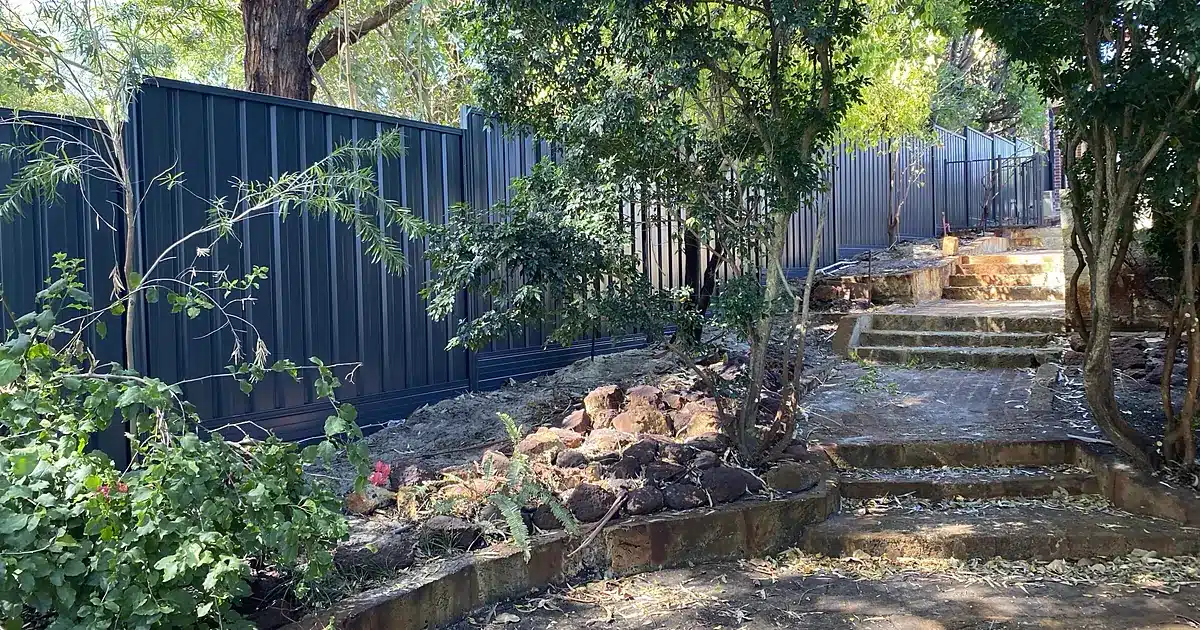
Stepped Colorbond Over Allywall Retaining: On a sloping bush block we stepped a Monument Colorbond boundary down the grade and carried it on Allywall retaining panels, holding level sightlines while retaining the fall of the land.
Raked Steel Battens Following The Fall: Here we engineered bespoke raked steel batten panels to follow a sloping retaining wall and front steps, keeping the top line true across the gradient rather than stepping it.
Panels Cut To Fit Limestone Piers: We measured and fabricated timber-look aluminium infill panels to drop neatly between a home’s existing limestone piers, working with the hard limestone rather than fighting it.
Frequently Asked Questions
The tricky-block fencing questions Perth homeowners ask us most:
Fence Any Block With Confidence
A slope, a corner or a bed of limestone does not have to mean a compromise on your fence, it just means it has to be built the right way. Whether that is stepping or raking the panels, retaining a steep block first, coring through rock, working around a treasured tree, or keeping a corner within the sight lines, the difference is knowing what each block needs and doing it properly. We build fences on Perth’s trickiest blocks every week, the steep, the rocky and the corner lots that other fencers walk away from. Get in touch today for expert advice and a free, no-obligation quote, and let us give you a straight, solid, great-looking fence, whatever your block throws at us.

With years of hands-on experience in the fencing industry, Niels founded FencrGatr with a mission to deliver premium fencing solutions backed by exceptional service across Perth.