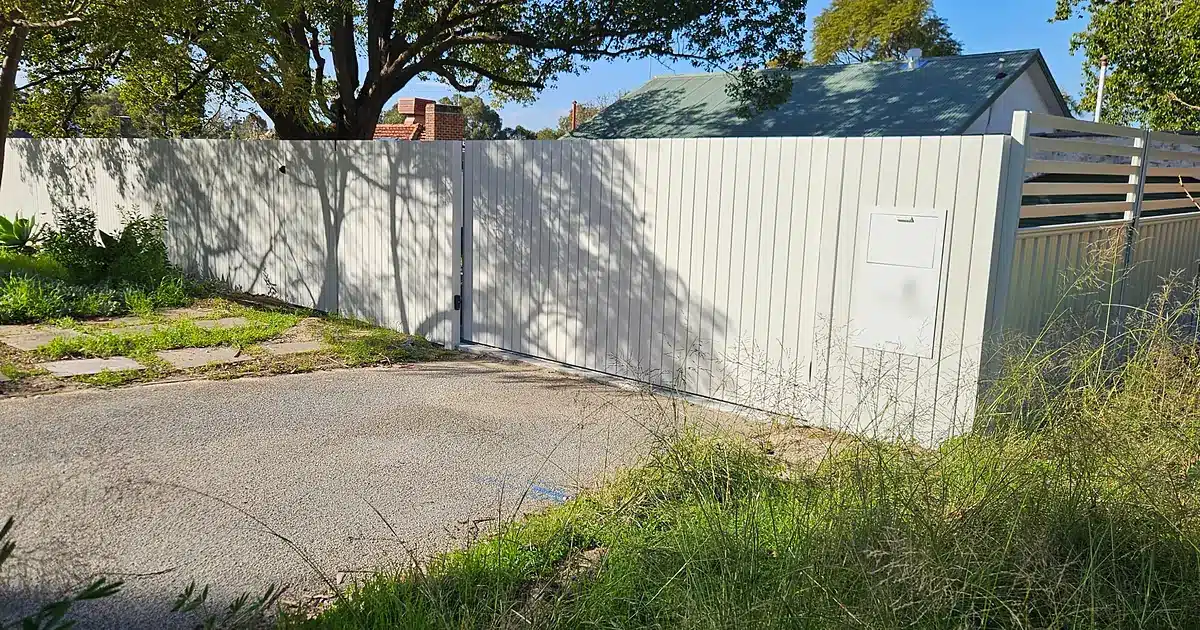
A driveway gate does a lot at once. It secures your property, frames the entrance and, once automated, means never climbing out of the car in the rain again. The big decision is how it opens: a swing gate that arcs open on hinges like a giant front door, or a sliding gate that glides sideways along the fence. It is not just about looks. Your driveway space, the slope of your block, how exposed you are to wind, your budget and how much security you want all point toward one or the other. We design and install both across Perth, so in this guide we compare sliding versus swing gates on every factor that matters, and help you work out which driveway gate is best for your place.
Sliding Vs Swing Gates: The Quick Answer
If you want the short version, here it is. Swing gates are simpler and cheaper, and they look right on a flat block with plenty of room to open. Sliding gates cost more but excel where space is tight, the driveway slopes, the opening is wide, or you are exposed to strong coastal wind. Here is how the two stack up at a glance:
| Factor | Swing Gate | Sliding Gate |
|---|---|---|
| Best for | Flat blocks with room to swing | Tight, sloped or wide driveways |
| Driveway depth needed | High, needs a clear arc | Low, opens sideways |
| Side room needed | Very little | Room along the fence to slide |
| Slopes | Needs flat ground | Handles slopes well |
| Wind | Catches the wind like a sail | Very stable in wind |
| Upfront cost | Lower | Higher |
| Security | Good, centre latch a weak point | Excellent, locks into a post |
| Maintenance | Hinges and wind strain | Keep the track clear |
The rest of this guide unpacks each of these, so you can match the right gate to your driveway.
How Each Gate Works
A swing gate is the traditional choice, hinged on posts at the sides so it swings open like a door, either as a single gate or a pair of double swing gates meeting in the middle. It can open inward or outward, and automated versions use a ram or an articulated arm at each hinge to do the work. A sliding gate runs sideways across the driveway on rollers, either along a floor track set into a concrete footing, or as a cantilever system that hangs from posts with no ground track at all. Automated sliding gates use a motor driving a toothed rack along the gate panel. Both can be manual or automatic, but on wider driveway openings and modern homes, sliding is the more common pick.
Space Requirements: Driveway Depth Vs Side Room
Space is usually the deciding factor, and the two gates need it in completely different places. A swing gate needs clear driveway depth to open, roughly the width of the gate swung through its arc, so a 3.5 metre single gate needs about 3.5 metres of clear space in front of it, and more again if a car might be waiting there. That rules swing gates out on many narrow or short driveways, where a parked car would simply block the arc. A sliding gate needs almost no depth. Instead it needs lateral space, a clear run along the fence line equal to the gate’s width plus a little extra, or for a cantilever gate, a panel around 30 to 50 percent longer than the opening. If your driveway is short but you have room to the side, sliding wins. If you have a deep, open forecourt, a swing gate is firmly on the table.
Slope And Ground Conditions
Slope is where sliding gates pull clearly ahead. Because a sliding gate moves sideways, parallel to the ground, it copes easily with a sloped or uneven driveway, and it is the standard choice for an uphill driveway or a steep incline. A swing gate, by contrast, needs flat, level ground through its whole arc. On a slope, an inward-opening swing gate will scrape the rising pavement, while an outward-opening one leaves an ever-growing gap underneath as the ground falls away. Perth’s ground matters here too: on the loose Bassendean and Spearwood sands that run through much of the metro, gate posts and a sliding gate’s track need a deeper, wider concrete footing to stay true, while closer to the coast the limestone belt can mean coring through rock to seat a floor track. If your driveway is anything but flat, a sliding gate is almost always the simpler, better-operating answer.
Wind Exposure And The Perth Factor
Perth throws real wind at a gate, and it changes the maths. A swing gate is a large solid panel on hinges, and in a strong gust it catches the wind like a sail, straining the hinges and the opener, especially on exposed or coastal blocks in the path of the Fremantle Doctor. A sliding gate moves along its track and stays stable even in high winds, which is why we so often recommend sliding for beachside and elevated properties. If you infill a swing gate for privacy, the wind load only grows, so on a windy site the opening mechanism and the hinge posts have to be built for it, or a sliding gate sidesteps the problem entirely.
Motor And Automation Options
Most driveway gates we install these days are automated, and honestly, once you have lived with one you will never want to go back. There is a small daily luxury in pulling up after work and having the gate glide open as you arrive, the kids and the dog safely closed in behind it. The gate type shapes the motor. A sliding gate uses a rack-and-pinion motor mounted beside the track, driving the gate along on its rollers, which is simple, strong and reliable. A swing gate uses either a ram, a linear actuator that pushes each leaf open, or an articulated arm for pillar-mounted gates, with double swing gates needing a motor on each leaf. Whichever you choose, a properly set up automatic gate includes safety sensors, or photocells, that stop and reverse the gate if something is in the way, plus a manual release mechanism so you can open it by hand during a power cut. Add access control to suit, whether a remote, a keypad, an intercom or your phone, and the gate becomes as convenient as it is secure.
The Cost Difference
Cost is where the two gates genuinely part ways. A swing gate is usually the cheaper option, both to buy and to install, because it has fewer parts, no track to lay and a simpler mechanism, and a manual swing gate is the least expensive of all. A sliding gate costs more, since it needs a motor, track or cantilever hardware, rollers and often a concrete footing for the track, all of which add to the install, and on Perth’s limestone blocks, cutting that footing into rock can nudge the price up further. Double swing gates and double sliding gates cost more again than their single versions, thanks to the extra hardware. As a rough rule, if you are working to a tight budget on a flat block, a swing gate saves you money, while a sliding gate earns its extra cost wherever space, slope or wind would fight a swing gate anyway.
Maintenance And Reliability
No gate looks after itself entirely, but the upkeep differs. A sliding gate’s main job is keeping the floor track clear, since leaves, dirt and stones in the track are the usual cause of a jam, so a cantilever gate with no ground track avoids that issue entirely. A swing gate has fewer things to clog, but its hinges carry all the weight of the leaf and take the strain of any wind, so they need occasional greasing and checking. Near the coast, it also pays to rinse the salt off the motor housing and hardware, because sea air is every bit as hard on gate gear as it is on your fence. Automated gates of either type benefit from a yearly service to keep the motor, sensors and safety features working smoothly. Look after the basics and both gate systems will give you years of reliable, smooth operation.
Security Comparison
For security, a sliding gate has the edge. When closed, it locks into a sturdy latch post and is very hard to force open, and there is no centre join to attack, which is one reason sliding gates dominate commercial and high-security sites. A swing gate is still a strong physical barrier and resists forced entry well when shut, but a pair of double gates meeting in the middle relies on a centre latch that can be the weaker point. There is real reassurance in knowing the only way onto your property is through a gate you control. Automating either gate lifts security further, removing the manual latch a person could reach over and open, and tying the gate into your fence line turns your whole frontage into a proper, controlled entrance rather than an easy way in.
Which Driveway Gate Is Best For You?
So which driveway gate is best? Choose a swing gate if your block is flat, you have generous depth in front of the gate, you love that traditional look of double gates opening onto a driveway, and you want to keep the cost down. Choose a sliding gate if your driveway is tight or short, the ground slopes, the opening is wide, you are exposed to coastal wind, or you simply prefer a clean, modern line. For many Perth blocks, especially narrow or sloping ones, sliding is the practical winner, while a flat acreage entrance is a swing gate’s natural home. If you are still unsure, a quick look at your driveway layout usually settles it, and that is exactly what we are here to help with.
Our Recent Gate Work In Perth
The right choice comes down to your driveway, slope and space, and our guide to choosing a gate style and width walks through it. Some recent driveway gates we have installed:
Double Swing Gate On A Sloping Driveway: A nine-metre double garrison swing gate suited this flatter entry with room to open, showing where a swing setup is the simpler, more cost-effective choice.
Surfmist Slat Double Gates: These Surfmist slat double gates were built to swing cleanly in a tight carport space, with careful sizing so the leaves clear the ground and each other every time.
Matching Gates Across Several Openings: With a welded front gate, Colorbond carport gates and a side gate all on one property, we matched the gate type to each opening rather than forcing one style everywhere.
Frequently Asked Questions
The driveway gate questions Perth homeowners ask us most:
Get The Right Gate For Your Driveway
Both gates can look fantastic and keep your property secure, so the right choice really comes down to your driveway. If you have a flat block with room to spare and want to keep costs down, a swing gate is a great fit. If space is tight, the ground slopes, the opening is wide or the wind is strong, a sliding gate will serve you better for years. Either way, automation adds the convenience and security that make a driveway gate genuinely worth it, that small lift every time it opens for you at the end of a long day. Tell us about your driveway and we will recommend the right gate and motor, then design and install it to suit your home.
Get in touch today for expert advice and a free, no-obligation quote, and let us build the entrance your property deserves.

With years of hands-on experience in the fencing industry, Niels founded FencrGatr with a mission to deliver premium fencing solutions backed by exceptional service across Perth.