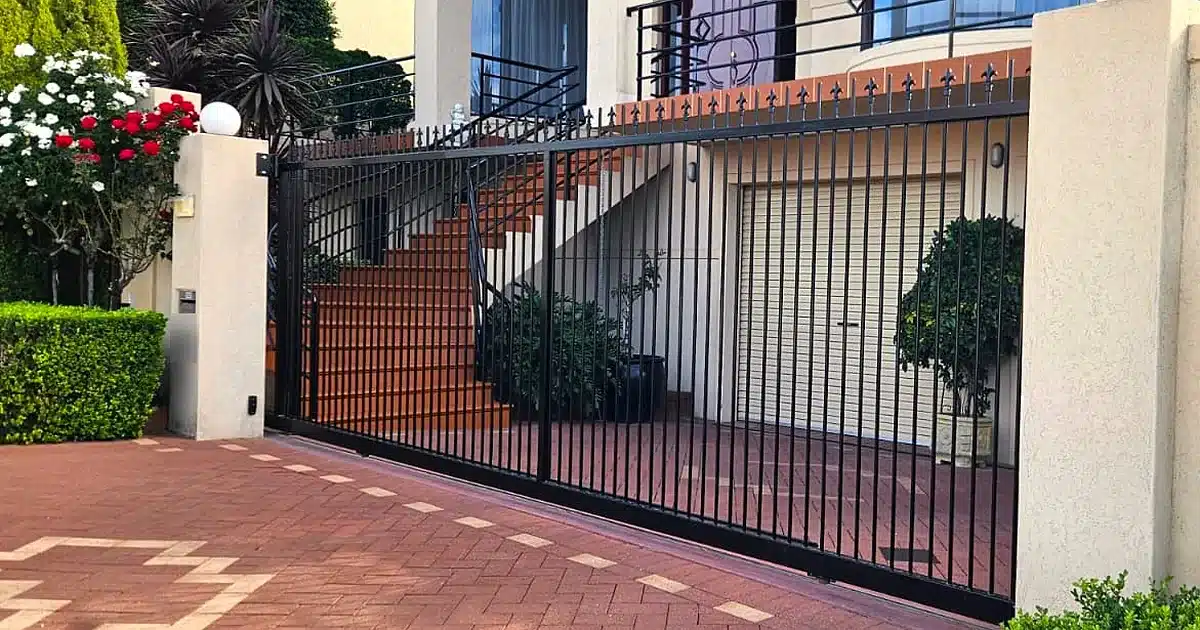
Ten years ago, an automatic gate was mostly a rural thing, or the mark of a serious mansion. Today they are going in on ordinary suburban blocks right across Perth, and anyone who has stood in the rain wrestling a padlock while the car idles behind them understands exactly why. An automatic gate turns your entrance into something you control from the seat of your car or the palm of your hand. Behind that ease sits a system of parts working together: a motor, a control board, safety sensors and the access controls you choose. In this guide we explain how automatic gate systems work, the motor types on offer, solar options, keypads and intercoms, what happens in a power cut, and why a automatic gate motor sometimes stops. Whether you are automating an existing gate or planning a new one, here is what actually matters.
How An Automatic Gate System Works
At its heart, every automatic gate system is made of three things: a motor that does the physical work, a control board that acts as the brain telling it when to open and close, and safety devices that stop it hurting anyone or anything. You trigger it with a remote control, a keypad, an intercom or an app, the control board fires up the motor, and the gate opens, pauses, then closes on a timer or a second command. Add-ons like safety beams, cameras and access control build out from there. It sounds complex, but for you it comes down to one thing: the gate opens at a tap and looks after the rest itself.
Gate Motor Types
The right motor depends on your gate, so it is worth choosing the right gate first. A sliding gate uses a rack-and-pinion motor that drives the gate along its track on rollers, and quality sliding gate openers can move heavy gates, some rated up to 800 kilograms, which handles long or solid gates with ease. A swing gate uses either a ram, a linear actuator that pushes each leaf open, or an articulated arm for gates on pillars, with double swing gate openers running a motor on each leaf. There are also underground motors for a hidden, tidy look on swing gates. The detail that matters most is motor sizing: we spec an opener comfortably stronger than the gate’s actual weight, so it never runs flat out, because an undersized motor labouring on a heavy gate is exactly what burns out early. We fit proven brands built for Australian conditions, like Centurion, BFT and Nice, rather than the cheapest kit online.
Solar-Powered Gate Motors
If running mains power to the gate is a hassle, a solar gate motor is the way around it. A small solar panel trickle-charges a battery that drives the gate, so there is no trenching cable across the driveway and no electrician needed for the power supply. A typical residential setup pairs a modest panel with a sealed battery sized for dozens of cycles a day, and we angle the panel to catch Perth’s northern sun so it keeps topping up through a run of grey July days. Solar openers work through cloudy weeks and low winter light, which is why they are so popular on rural and acreage blocks where the gate sits a long way from mains power, though they suit plenty of suburban homes too. It is a genuinely energy efficient way to automate a gate anywhere the sun reaches.
Keypads, Intercoms And Smart Access
How you open the gate is where it gets clever. The classic is a remote control on the visor, but most systems now offer far more. A keypad lets you or a trusted visitor tap in a code, while gate intercom systems let you see and speak to whoever is at the gate, and buzz them in, from a handset inside or straight from your phone. App and smartphone control is the big shift: open the gate from anywhere, let a courier or tradie in while you are at work, and get an alert whenever the gate is used. It is part of a bigger change, too. As more of the home goes connected, with cameras, video doorbells and alarms, the gate becomes the outer layer of that security, the first call on who gets past the boundary at all. In an age of constant online deliveries, granting a courier one-time access from your phone has gone from gimmick to genuinely handy.
What Happens In A Power Outage?
A common worry is being locked in or out when the power goes down, but a well set up automatic gate has this covered. Most systems include a battery backup that keeps the gate running for a number of cycles during an outage, so a short blackout is a non-event. For longer outages, every automatic gate has a manual release: a key or lever that disengages the motor so you can slide or swing the gate by hand, then re-engage it when the power returns. Solar gates run on their battery by design, so they shrug off a grid outage altogether. Either way, you are never actually trapped.
Safety Features You Need
An automatic gate is a heavy, moving object, so safety is not optional. The core feature is a pair of safety beams, or photocells, across the opening: if anything breaks the beam while the gate is closing, a car, a child, a pet, the gate stops and reverses instead of crushing it. Good openers also limit their force, easing off the moment they meet resistance. In Australia, automated gates should meet the relevant safety standards, and getting the sensors positioned and the force set correctly is a big part of a proper install. It is exactly why professional setup matters on anything with a motor and a mind of its own.
Why Is My Gate Motor Not Working? Faults And Servicing
When a gate suddenly stops, it is usually something simple, though there is nothing quite like the sinking feeling of a gate frozen shut when you are already running late. If you are asking why is my gate motor not working, start with the basics. Check the power is on and no breaker has tripped, then try fresh batteries in the remote or keypad, because a flat remote battery is the most common call-out we get. Next, look at the safety beams: if they are misaligned, dirty or blocked by a stray branch or bin, the gate refuses to close as a safety measure. For sliding gates, clear any leaves or stones jammed in the track. The part that quietly fails most is the backup battery, which usually needs replacing every two to three years, well before people expect it. On a yearly service we test that battery, realign the beams, check the force settings and clean the control board terminals, which corrode faster near the coast. Look after it and a quality gate opener runs smoothly for years.
Our Recent Gate Automation Work In Perth
Automation is only as good as the gate it is fitted to. A few recent gates we built automation-ready:
Slat Gates On Borg Digital Locks: We fitted double-access and pedestrian gates on Borg digital locks to this Jasper slat perimeter, delivering keyless, controlled entry that pairs neatly with automated access.
Heavy-Duty Double Swing Gate, Automation-Ready: This nine-metre double garrison swing gate was hung on posts and a frame built to carry a motor, so adding automation later is a straightforward upgrade rather than a rebuild.
Slat Gates Built Square And Solid: The square frames and solid posts on these Surfmist slat gates make them an ideal candidate for a motor, with the strength and clearance an automatic system needs to run smoothly.
Frequently Asked Questions
The automatic gate questions Perth homeowners ask us most:
Automate Your Gate The Right Way
Get an automatic gate right and you stop thinking about it, which is really the whole point. The motor is sized to the gate, the access suits how you actually live, and it keeps working through blackouts, storms and the odd curious kid. Get it wrong, with an undersized motor or a rushed install, and it becomes a weekly headache. The difference is almost always in the setup, not the badge on the box. Whether you want to automate an existing gate, add smart access, or revive a motor that has given up, we would rather do it once and do it properly. Get in touch today for a chat and a free, no-obligation quote, and we will sort you out a gate that simply works.

With years of hands-on experience in the fencing industry, Niels founded FencrGatr with a mission to deliver premium fencing solutions backed by exceptional service across Perth.