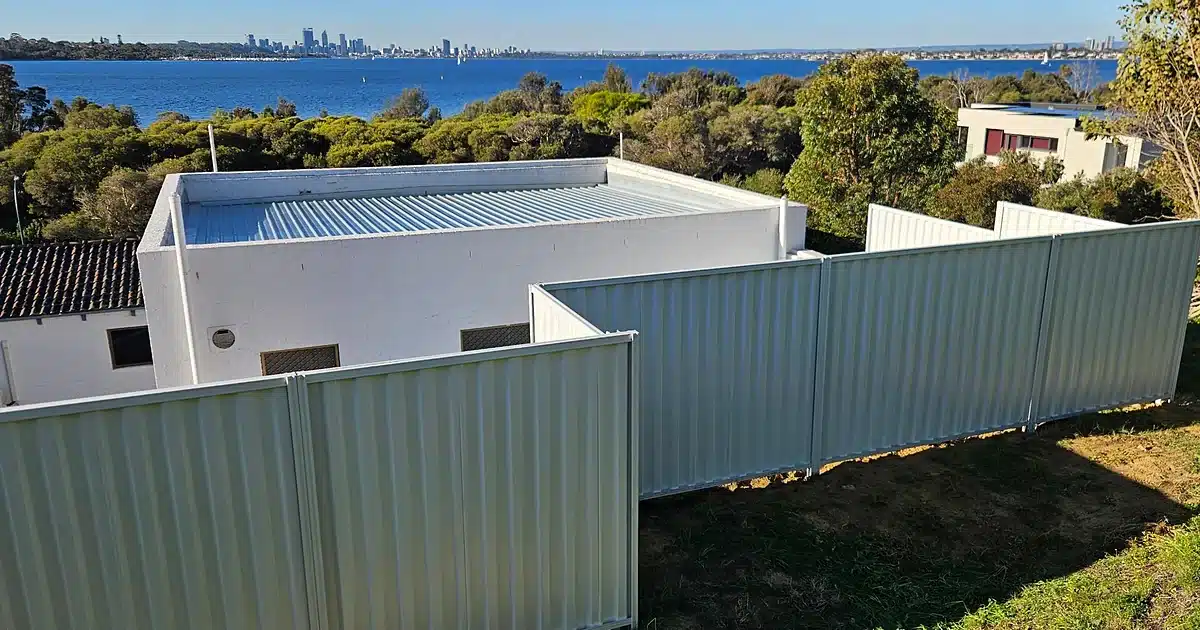
A fence is your property’s first line of defence, and a well designed one does far more than mark a boundary, it quietly tells an opportunist to move along to an easier target. Most break-ins are crimes of opportunity, so the goal of security fencing is simple: make your place look too hard, too slow and too visible to bother with. The good news is you do not need a prison wall to manage it. A handful of proven design features, the right height, an anti-climb build, smart gates, good lighting and cameras, and a tidy perimeter, work together to deter intruders, and well-designed fencing can reportedly cut break-ins by up to half. In this guide we walk through exactly how to make your fence more secure, for homes and commercial sites alike, and how to do it within Perth’s council rules.
How To Make Your Fence More Secure: The Basics
Good security fencing works on a simple principle the professionals use the world over: deter, delay and detect. You want to deter the intruder before they try, delay anyone who does attempt it long enough that it is not worth the risk, and raise the chance they are seen and noticed. No single feature does all three, which is exactly why the best security is layered. A tall, hard-to-climb fence deters and delays, lighting and cameras detect, and a clear, open perimeter means neighbours and passers-by can spot anyone who lingers. This idea has a name, CPTED, or Crime Prevention Through Environmental Design, and it underpins everything that follows. Think of your fence not as one barrier but as the backbone of a layered security solution, and every upgrade from here simply adds another layer an intruder has to beat.
Height: Your First Line Of Defence
Height is the most basic and effective security feature, because a fence that is genuinely hard to get over stops most opportunists cold. As a rule, a security fence should be at least 1.8 metres tall, and 2 metres or a touch more is better where the rules allow, since every extra bit of height makes it harder to scale or throw a leg over. Taller solid panels also block the view of what is worth stealing, so an intruder cannot case your yard from the street before they even approach. Bear Perth’s council limits in mind, though: most back and side boundaries are capped around 1.8 to 2.1 metres, and anything over 2 metres usually needs council approval. Front fences are a special case we come back to later, but for your rear and side perimeter, get the height right first, because it is the foundation every other feature builds on.
Anti-Climb Design: Remove The Footholds
A tall fence is only as good as its climbability, and this is where anti-climb fence design earns its keep. The whole trick is to give an intruder nothing to grip or stand on. Put the smooth face of the fence, the vertical pickets or flat sheets, on the outside, and keep the horizontal rails on the inside, so they cannot be used as ladder rungs from the street. A flat Colorbond sheet or a smooth tubular panel offers no foothold at all. Then make sure every panel is screwed firmly through into the posts, not just slotted in, so nobody can lift or slide a section out to climb through or squeeze past. These are small details, but together they turn a fence that can be over in seconds into one that stops a climber cold. Getting the anti-climb build right matters more than almost anything you bolt on top of it.
Anti-Climb Tops And Toppers
When you need to push security further, the top of the fence is where you add it. Anti-climb toppers make the very top impossible to grab or clear: the options include angled anti-climb spikes, rotating rollers that spin a would-be climber straight back off, and heavy-duty brackets that carry the extra height. Rotating rollers are a favourite for homes because they are highly effective without looking aggressive. For high-security and commercial sites, barbed wire and razor wire go further again, though in urban and residential Perth these are heavily restricted and usually need council approval, so they are rarely an option on a suburban block. A licensed contractor should fit any security topping so it is installed correctly and safely. Match the topper to the setting, subtle rollers or spikes for a home, serious wire for a yard that genuinely needs it, and the fence top stops being the obvious weak point.
Spacing And Anti-Climb Mesh
Spacing is a quieter but important part of a climb-resistant fence. Wide gaps or big mesh apertures give fingers and toes an easy hold, so a proper anti-climb mesh uses apertures too small for anyone to grip or wedge a boot into. Chain link, or chainmesh, comes in different gauges and aperture sizes for different security levels, from a basic boundary right up to a serious commercial perimeter. On vertical steel or aluminium tubular fencing, keeping the verticals close together stops a foot slipping between them while still allowing clear visibility. The principle is the same throughout: leave nothing a hand or foot can use as a step. Fine anti-climb mesh is the specialist answer wherever climb resistance is the number one priority.
Lighting And Camera Integration
Physical barriers deter and delay, but lighting and cameras are what detect, and they are two of the most cost-effective security upgrades you can make. Motion-sensor floodlights mounted along the fence line strip away the cover of darkness, and nothing unsettles an intruder like suddenly being lit up mid-attempt. Visible security cameras or CCTV do their work before anyone even tries, because the clear signal that a property is monitored sends most opportunists looking elsewhere. The two are best combined and integrated with the fence: lights on the approaches and the side path, cameras covering the gates and the vulnerable corners. Modern systems tie into your phone, so you can see and even speak to whoever is at the boundary from anywhere. A fence that watches back is a powerful deterrent, and it is often the layer that turns a good security fence into a genuinely hard target.
Secure Gates And Hardware
A gate is the weak link in most fences, and a lockable side gate is one of the most common entry points thieves use, so it deserves proper hardware. Skip the basic latch with a hole an arm can reach through from the outside to flip it open, and fit a self-locking latch or a double-sided deadbolt that can only be worked with a key. Just as important, reinforce the hinges: use non-removable hinge pins, or cover the hinge screws with security brackets, so nobody can simply unscrew the gate and lift it clean off. Make sure the gate matches the height of the fence, with no handy gap above or below, and that it closes and locks securely every single time. Get the gate right and you shut off the easiest way in, because a strong fence with a weak gate is really no security at all.
Defensive Landscaping And Clear Sight Lines
Your fence works best with a bit of help from the garden, an approach the police call defensive landscaping. First, clear the perimeter of anything that offers a leg-up or a hiding spot: trim back trees and large bushes near the boundary, and move bins, ladders, stacked items and outdoor furniture well away from the fence. Then use planting to your advantage, with dense, thorny shrubs like roses or bougainvillea under windows and along vulnerable stretches making an uncomfortable barrier nobody wants to push through. There is a balance out the front, though. WA police actually advise against high, solid front walls, because they create hiding spots and block the natural surveillance of neighbours and passers-by. A lower or visually permeable front fence that keeps clear sight lines into the yard is often safer, letting the street act as an extra set of eyes. Save the tall, solid, climb-proof fencing for the sides and rear where it belongs.
Materials That Resist Climbing And Vandalism
The material you build in shapes how secure and how vandal-resistant the finished fence is. Colorbond and smooth steel or aluminium tubular fencing are excellent for homes: they offer no footholds, they are tough, and a solid Colorbond fence blocks the view while resisting climbing. For deterring vandalism, durability is everything, since a smooth, hard-wearing surface shrugs off graffiti and knocks far better than soft timber, and quality steel is hard to cut or break through. Palisade fencing, with its strong vertical pales and pointed tops, is the classic high-security choice where a serious barrier is called for. Chain link suits large perimeters and can be upgraded for more security. Near the coast, choose marine-grade materials so the fence does not corrode and weaken over time, and remember that Perth’s sandy soils need solid footings to anchor a heavy security fence firmly. The right material quietly makes every other feature work harder.
Commercial And High-Security Fencing
Businesses, construction sites and high-security properties have needs a home simply does not, and the fencing steps up to match. Commercial security fencing prioritises a hard physical barrier and controlled access over looks. Palisade and welded mesh fencing give a strong, see-through perimeter that is hard to climb or cut, chainmesh with barbed or razor-wire toppers suits industrial yards and construction sites, and heavy, lockable gates with automation and access control manage exactly who comes and goes. Visibility is still your friend here: a see-through high-security fence lets staff and cameras watch the perimeter, unlike a solid wall that hides an intruder the moment they are over it. Whether it is a warehouse, a compound, a school or a site shed, the same deter-delay-detect thinking scales straight up, just with tougher materials and serious access control on the gates.
Perth Rules And Practical Limits
Security still has to work within the rules, and Perth’s councils set clear ones. Most back and side fences are capped at 1.8 to 2.1 metres, and anything over 2 metres generally needs council approval. Solid front fences are usually limited to 1.2 metres unless the upper portion is visually permeable, which happens to line up neatly with the police advice on keeping sight lines open. Barbed and razor wire are restricted in urban and residential areas and often need approval, so they remain mainly a commercial tool. Security toppings should be fitted by a licensed contractor, both for safety and to keep everything above board. None of this stops you building a genuinely secure fence, it just means designing within the guidelines, which is exactly what we do on every job.
Our Recent Security Fencing Work In Perth
Real security comes from height, hardware and giving intruders nothing to grip. A few recent secure boundaries we have built:
Full-Height Garrison Perimeter With A 9m Gate: We enclosed a boundary in satin black garrison fencing with a heavy-duty double swing gate nine metres wide and a matching pedestrian gate, a tall, spike-topped perimeter that is genuinely hard to get over.
Graduated Slats On Borg Digital Locks: This Jasper aluminium slat perimeter used enclosed slats below for privacy and spaced slats above for sightlines, with double-access and pedestrian gates on Borg digital locks for keyless, controlled entry.
Engineered Steel Batten Boundary: Millimetre-perfect satin black steel battens, raked to follow the site and set on solid footings, gave this home a secure, dog-proof boundary with clean lines and no easy footholds. For dogs specifically, our guide to fencing that keeps dogs in goes further.
Frequently Asked Questions
The security fencing questions Perth homeowners ask us most:
Build A Fence Intruders Skip
A secure fence is not about one dramatic feature, it is about layering the simple ones that genuinely work: enough height, an anti-climb build with no footholds, a well-topped fence line, secure gates, good lighting and cameras, and a clear, open approach. Done together, and designed within Perth’s council rules, they turn your property from an easy target into one an intruder walks straight past. Whether you want to secure a family home, a rural block or a commercial site, we design and build security fencing that genuinely deters, and looks good doing it. Get in touch today for expert advice and a free, no-obligation quote, and let us build you a fence that keeps what matters safe.

With years of hands-on experience in the fencing industry, Niels founded FencrGatr with a mission to deliver premium fencing solutions backed by exceptional service across Perth.